
Travelling to another country for medical treatment requires more preparation than an ordinary international journey. Along with choosing the hospital and specialist, patients must ensure that their immigration documents correctly reflect the purpose and expected duration of their stay.
India provides dedicated visa categories for foreign nationals travelling for medical treatment and for eligible family members or attendants accompanying them. Understanding these categories before arranging travel can help prevent avoidable delays at the visa, immigration and treatment stages.
Understanding the Indian Medical Visa
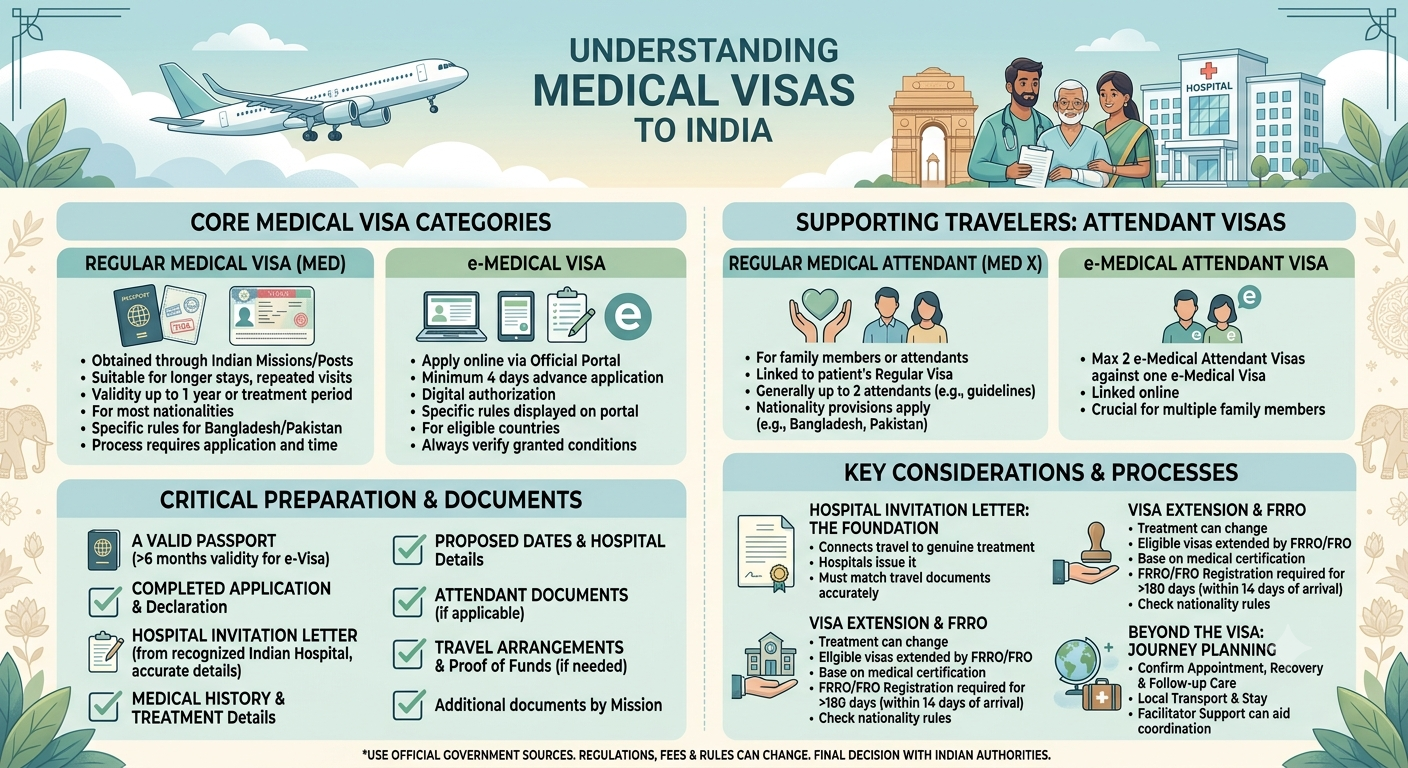
A Medical Visa (MED Visa) is intended for foreign nationals travelling to India primarily to receive treatment at an established, recognised or specialised hospital or treatment centre. India's Ministry of Home Affairs also provides for treatment under recognised Indian systems of medicine within the applicable medical-visa framework.
Depending on nationality, treatment duration and eligibility, a patient may use either a regular Medical Visa obtained through an Indian Mission/Post or the e-Medical Visa facility available to eligible nationalities.
Patients should not assume that a tourist visa is automatically suitable simply because their proposed treatment is short. Where medical treatment is the principal purpose of travel, the appropriate medical-visa category should be considered.
Regular Medical Visa and e-Medical Visa
The regular Medical Visa is particularly relevant where treatment may require an extended stay, repeated hospital visits or visa extension.
Under the Ministry of Home Affairs' regular Medical Visa policy for most nationalities, the initial MED Visa or Medical Attendant Visa may be issued for up to one year or the treatment period, whichever is shorter. Indian Missions may apply different validity or entry conditions depending on the applicant's nationality and circumstances. Bangladesh and Pakistan are specifically subject to separate provisions.
India also operates an online e-Medical Visa system for eligible countries and territories. The e-Visa portal requires applications for e-Medical and e-Medical Attendant categories to be submitted at least four days before arrival and permits applications within the applicable advance application window.
Visa validity rules can be revised. Applicants should therefore verify the conditions displayed on the official e-Visa portal and, most importantly, check the exact validity and entry conditions stated on the Electronic Travel Authorisation or visa actually granted.
What Is a Medical Attendant Visa?
A patient who requires assistance during treatment may be accompanied by eligible attendants or family members under the Medical Attendant Visa (MED X) category.
For regular Medical Visas, the attendant's visa is generally linked to the patient's Medical Visa. Under the Ministry of Home Affairs guidelines, ordinarily up to two attendants may accompany a patient. Specific nationality-based provisions apply: the published regular-visa policy allows up to three attendants for Bangladeshi nationals and one for Pakistani nationals.
For the e-Visa route, the official portal states that a maximum of two e-Medical Attendant Visas are granted against one e-Medical Visa.
This distinction is important when a patient intends to travel with several family members.
Documents Patients Should Prepare
Exact requirements may differ by nationality and by the Indian Mission processing the application. However, patients should generally prepare their documentation well before the intended travel date. Important documents can include:
- A valid passport and recent photograph meeting the applicable specifications.
- Completed visa application and required declarations.
- Medical Visa Invitation Letter or treatment/appointment letter from the hospital in India.
- Relevant medical information supporting the purpose of treatment, where requested.
- Proposed treatment dates and hospital details.
- Documents relating to accompanying attendants.
- Evidence of travel arrangements or ability to support the stay where required.
- Additional documents requested by the relevant Indian Mission, Consulate or visa-processing centre.
For an e-Medical Visa, the Government of India's portal specifically requires the passport bio page and a letter from the concerned Indian hospital on its letterhead indicating the proposed or tentative admission date. The passport should ordinarily have at least six months' validity when the e-Visa application is made.
The Importance of the Hospital Invitation Letter
The hospital invitation letter is one of the most important documents in the medical-visa process. It connects the patient's proposed journey with a genuine treatment arrangement in India.
Government guidelines envisage hospitals issuing medical invitation or appointment documentation and, where required, sharing prescribed information with the appropriate Indian Mission or Post. Hospitals may also provide supporting documentation where visa registration or extension becomes necessary.
Patients should ensure that names, passport details and other information appearing in hospital documents correspond accurately with their travel documents. Even small discrepancies can create unnecessary complications.
Visa Extension and FRRO Requirements
Certain treatments do not follow a predictable timetable. Surgery may be followed by rehabilitation, additional procedures or prolonged clinical observation.
Under the regular Medical Visa framework, eligible visas may be extended by the Foreigners Regional Registration Office (FRRO) or Foreigners Registration Office (FRO) on the basis of appropriate medical certification from recognised institutions, subject to applicable rules.
For most foreign nationals holding a regular Medical or Medical Attendant Visa exceeding 180 days, the published policy requires FRRO/FRO registration within 14 days of arrival. Visas valid for 180 days or less generally do not require such registration under that policy, although nationality-specific rules may differ.
Patients should address extension requirements before their existing permission expires rather than waiting until the final days of validity.
Planning the Journey Beyond the Visa
Visa approval is only one part of a successful medical journey. Patients should also confirm their hospital appointment, expected treatment duration, accommodation, local transportation, estimated recovery period and arrangements for follow-up care before finalising travel.
A medical travel facilitator such as Cadupius Healthassist can support international patients by coordinating with hospitals, assisting with appointment and Medical Visa Invitation Letter requests, helping organise the treatment journey and maintaining communication between the patient, hospital and other relevant stakeholders. Such coordination does not replace medical advice or the authority of the hospital, Indian Mission or immigration authorities.
Final Consideration
A well-prepared medical-visa application begins with accurate information and documented treatment arrangements. Patients and attendants should use official Government of India sources for the latest visa requirements and verify nationality-specific conditions before booking travel.
Visa regulations, eligibility, fees and documentation requirements can change. The final decision regarding visa issuance, validity and conditions rests with the competent Indian authorities.
Official Reference Sources
Government of India – Indian Visa Online / e-Visa Portal: information on e-Medical Visas, attendant visas, required documentation, application timelines and eligibility.
Ministry of Home Affairs, Government of India – Foreigners, Tourists and Visa: official policy guidelines covering Medical Visa, Medical Attendant Visa, validity, attendants, registration and extensions.
Ministry of Home Affairs e-VISA Information: current government information and links concerning India's e-Visa programme.
Medical and Visa Disclaimer
This article has been prepared for general informational and educational purposes only. It should not be considered a substitute for professional medical, legal, or immigration advice. Medical visa rules, eligibility criteria, required documentation, and other conditions may change from time to time. Before applying, applicants should verify the latest requirements with the relevant Indian Embassy or High Commission, the official Indian visa portal, or the appropriate authorized authority.