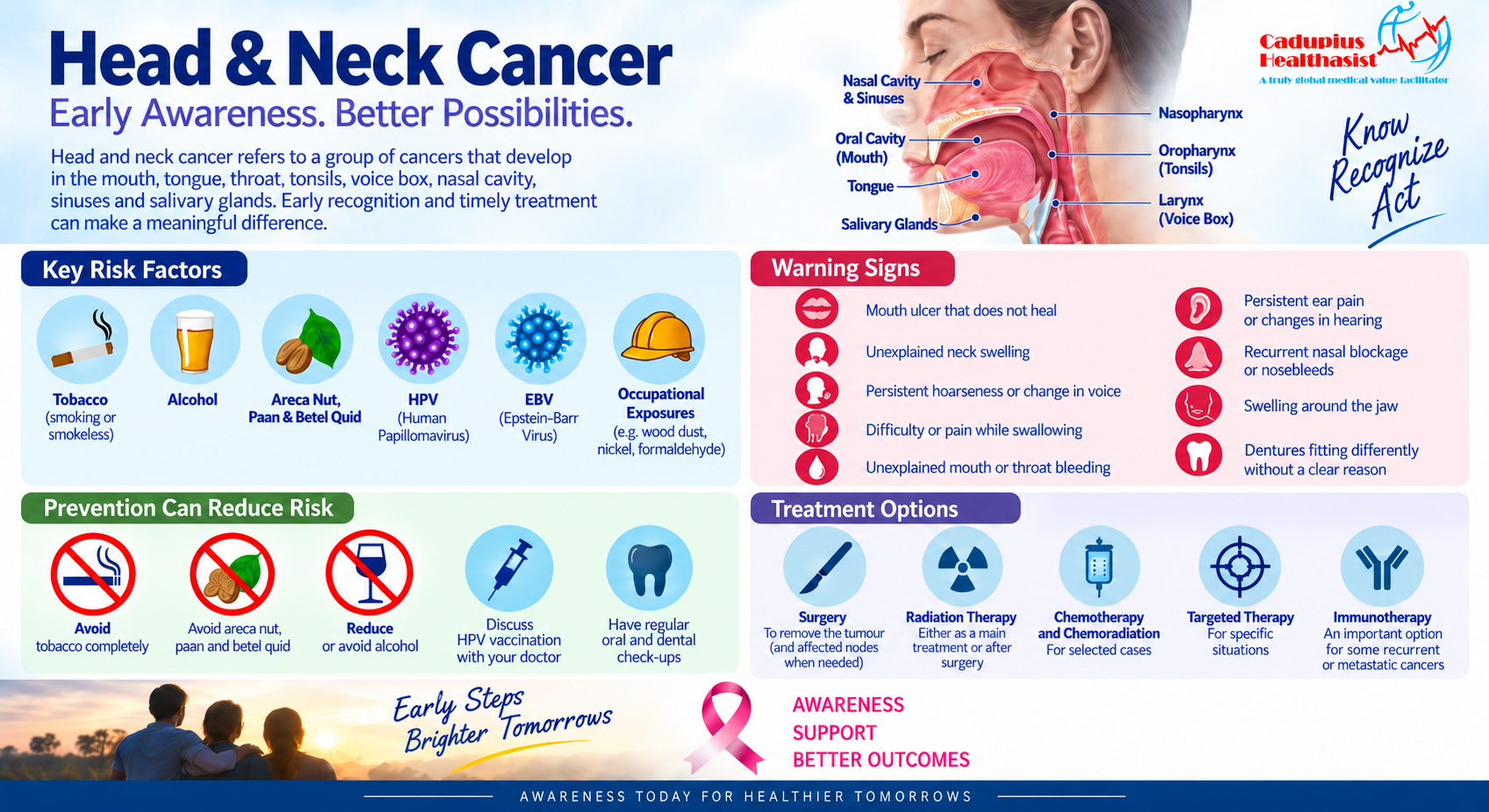
Head and neck cancer is not one single disease. The term describes a group of cancers that develop in areas such as the mouth, tongue, throat, tonsils, voice box, nasal cavity, sinuses and salivary glands. Most of these cancers begin in the squamous cells that line the moist surfaces of the mouth, nose and throat and are therefore known as head and neck squamous cell carcinomas (HNSCC).
Although advances in surgery, radiation therapy, imaging and systemic treatments have significantly expanded treatment possibilities, early recognition continues to be important. A persistent mouth ulcer, unexplained neck swelling or prolonged change in voice should therefore not simply be ignored.
What Causes Head & Neck Cancer?
Cancer usually develops through a combination of cellular changes and exposure to risk factors over time. In an individual patient, it may not always be possible to identify one precise cause.
Tobacco
Tobacco remains one of the most important preventable risk factors. The risk is associated not only with cigarettes but also with cigars, pipes and smokeless forms of tobacco.
For countries in South Asia, this is particularly relevant because chewing tobacco products are widely used. Long-term exposure can repeatedly damage the lining of the mouth and throat, increasing the likelihood of malignant cellular changes.
Alcohol
Regular alcohol consumption increases the risk of cancers involving areas such as the oral cavity, pharynx and larynx. The danger becomes particularly important when tobacco and alcohol are used together; their combined effect can produce a substantially greater risk than either exposure alone.
Areca Nut, Paan and Betel Quid
Areca nut and betel quid deserve special attention in India, Bangladesh and other parts of South and Southeast Asia.
The International Agency for Research on Cancer (IARC) identifies areca nut, with or without tobacco, as an established risk factor for oral cancer. Paan or betel quid should therefore not be regarded as harmless simply because tobacco has not been added to it.
Human Papillomavirus (HPV)
Certain high-risk types of human papillomavirus, particularly HPV-16, are strongly associated with cancers of the oropharynx—the part of the throat that includes the tonsils and base of the tongue.
Unlike many traditional head and neck cancers, HPV-related oropharyngeal cancer may occur in people without a long history of smoking or heavy alcohol consumption. HPV-positive oropharyngeal cancers can also behave differently from HPV-negative disease, which is one reason HPV status can be important when treatment is planned.
Epstein-Barr Virus
Epstein-Barr virus (EBV) has a recognised association with nasopharyngeal cancer, a cancer arising in the upper part of the throat behind the nose.
Occupational and Environmental Exposures
Certain workplace exposures, including wood dust, nickel dust and formaldehyde, have been associated with cancers involving the nasal cavity and paranasal sinuses. Appropriate workplace protection is therefore an important part of risk reduction in relevant occupations.
Warning Signs That Should Not Be Ignored
Symptoms vary depending on where the cancer develops. Many of these symptoms are caused by conditions other than cancer, but persistent or unexplained changes deserve medical evaluation.
Important warning signs can include:
- A mouth ulcer or sore that does not heal
- A persistent red or white patch inside the mouth
- An unexplained lump or swelling in the neck
- Persistent sore throat
- Difficulty or pain while swallowing
- Persistent hoarseness or change in voice
- Unexplained mouth or throat bleeding
- Persistent ear pain or changes in hearing
- Recurrent nasal blockage or unexplained nosebleeds
- Swelling around the jaw
- Numbness or weakness involving part of the face
- Dentures suddenly becoming uncomfortable or fitting differently without an obvious dental explanation
These symptoms do not automatically indicate cancer. However, symptoms that persist or progressively worsen should be assessed by an appropriate doctor, dentist or ENT specialist rather than repeatedly treated without establishing the cause.
Can Head & Neck Cancer Be Prevented?
Not every head and neck cancer is preventable, but several important risk factors can be reduced.
Avoid Tobacco Completely
Stopping smoking and avoiding smokeless tobacco are among the most meaningful preventive measures. The benefit also remains important after treatment because continuing to smoke can increase the risk of additional cancers and may adversely affect treatment outcomes.
Avoid Areca Nut and Betel Quid
People who chew supari, areca nut, paan or betel quid, even without tobacco, should understand that these products are associated with increased oral-cancer risk. IARC's review concluded that stopping areca-nut use can reduce oral-cancer risk.
Reduce or Avoid Alcohol
Cancer risk generally increases with alcohol exposure. Reducing or avoiding alcohol, particularly in combination with tobacco cessation, can lower preventable cancer risk. WHO and IARC recognise alcohol as a carcinogenic exposure associated with cancers of the oral cavity, pharynx and larynx.
Consider HPV Vaccination
HPV vaccination can prevent new infections with the high-risk HPV types responsible for several cancers. Vaccination is most effective before exposure to HPV and does not treat an existing HPV infection.
Eligibility and vaccination schedules differ by country and age, so individuals should discuss appropriate vaccination with their doctor or follow their national immunisation recommendations.
Maintain Regular Oral and Dental Care
There is currently no single standard population-wide screening test covering all head and neck cancers. Nevertheless, routine dental examinations can provide an opportunity to identify suspicious abnormalities within the oral cavity.
People with substantial tobacco, smokeless-tobacco or areca-nut exposure should be particularly attentive to persistent changes in the mouth. IARC has also concluded that clinical oral examination of high-risk populations may help reduce oral-cancer deaths.
How Is Head & Neck Cancer Treated?
Treatment is highly individualised. Decisions depend upon the exact location of the tumour, pathology, stage, involvement of lymph nodes, HPV status where relevant, previous treatment and the patient's general health and functional needs.
Ideally, treatment planning involves a multidisciplinary team that may include head and neck surgical oncologists, radiation oncologists, medical oncologists, radiologists, pathologists, reconstructive surgeons, dental specialists, dietitians and speech/swallowing specialists.
Surgery
Surgery may be used to remove an early or locally confined tumour and, when necessary, affected lymph nodes in the neck.
Modern head and neck surgery increasingly considers not only removal of the cancer but also preservation or reconstruction of structures responsible for speech, swallowing, appearance and breathing.
Radiation Therapy
Radiotherapy may be used as the main treatment for certain cancers or after surgery where there is concern about microscopic residual disease or risk of recurrence.
Modern radiation techniques allow treatment teams to shape radiation more closely around the tumour while attempting to reduce exposure to nearby healthy tissues.
Chemotherapy and Chemoradiation
For some locally advanced cancers, chemotherapy is administered together with radiation therapy. In other situations, systemic chemotherapy may form part of treatment for recurrent or metastatic disease.
The drugs, timing and combinations used vary according to the cancer site, stage and patient's ability to tolerate treatment.
Targeted Therapy
Targeted drugs are available for selected head and neck cancers. These medicines interfere with particular biological pathways that cancer cells use for growth or survival.
They are not appropriate for every patient, and their role depends on the specific clinical situation.
Immunotherapy
Immunotherapy has changed the treatment landscape for certain forms of head and neck squamous cell carcinoma, particularly recurrent or metastatic disease.
Immune-checkpoint medicines such as pembrolizumab are established treatment options in appropriately selected patients, with factors such as tumour characteristics and PD-L1 expression potentially influencing treatment decisions. Clinical trials such as KEYNOTE-048 helped establish immunotherapy as an important option in recurrent or metastatic HNSCC.
Treatment continues to evolve. For example, in June 2025 the U.S. FDA expanded the use of pembrolizumab into the perioperative setting for certain patients with resectable, locally advanced, PD-L1-positive HNSCC. Regulatory approval and clinical availability can differ between countries, so such therapies must always be considered by the treating oncology team.
Rehabilitation Is Also Part of Treatment
Successful head and neck cancer care extends beyond eliminating the tumour.
Depending upon the treatment received, patients may require speech and swallowing therapy, nutritional support, dental care, physiotherapy, reconstructive procedures or rehabilitation following surgery.
These services can make a major difference to a patient's ability to eat, communicate and return to everyday activities.
How Cadupius Healthassist Can Help International Patients
For a patient considering treatment in India, navigating hospitals, appointments, documentation and international travel while dealing with a cancer diagnosis can become complicated.
Cadupius Healthassist Pvt. Ltd., as a medical tourism facilitation company, can help international patients coordinate their treatment journey with renowned hospitals and appropriate hospital departments in India.
Depending upon the patient's requirements, Cadupius can assist with hospital and specialist appointment coordination, obtaining hospital treatment estimates, Medical Visa Request Letter coordination, scheduling, communication with the hospital, travel-related planning and other non-clinical aspects of the medical journey.
Cadupius Healthassist does not diagnose cancer, prescribe treatment or replace the opinion of a qualified oncologist. Medical recommendations and treatment decisions remain entirely with the patient's treating doctors and hospital specialists.
The objective is to make the treatment journey more organised, transparent and easier to navigate so that patients and their families can concentrate on the part that matters most—their treatment and recovery.
Medical Disclaimer
This article is intended solely for general education and information. It is not a substitute for professional medical advice, diagnosis or treatment. Anyone experiencing persistent symptoms or concerned about head and neck cancer should consult an appropriately qualified doctor, dentist, ENT specialist or oncologist. Treatment decisions must always be made by the treating medical team after individual clinical assessment.
Sources & References
- National Cancer Institute (NCI), U.S. National Institutes of Health. Head and Neck Cancers – Fact Sheet. Provides evidence-based information on tumour sites, risk factors, symptoms, prevention, treatment and rehabilitation.
- National Cancer Institute. Treatment of Head and Neck Cancer in Adults – PDQ® Health Professional Version. Evidence-based treatment information for oral cavity, oropharyngeal, laryngeal, hypopharyngeal, nasopharyngeal, sinonasal and salivary-gland cancers.
- Centers for Disease Control and Prevention (CDC). Head and Neck Cancers Basics, updated June 2025. Covers risk factors, symptoms and prevention.
- Centers for Disease Control and Prevention. HPV and Oropharyngeal Cancer. Information on HPV transmission, oropharyngeal cancer and HPV vaccination.
- International Agency for Research on Cancer (IARC), World Health Organization. IARC Handbooks of Cancer Prevention, Volume 19: Oral Cancer Prevention. Evaluates evidence concerning tobacco, alcohol, smokeless tobacco, areca nut and prevention of oral cancer.
- World Health Organization. Oral Health Fact Sheet, March 2025. Includes global oral-cancer information and established risk factors including tobacco, alcohol and areca nut.
- Chow LQM. Head and Neck Cancer. New England Journal of Medicine. 2020;382:60–72. DOI: 10.1056/NEJMra1715715. A major peer-reviewed clinical review covering the biology, diagnosis and management of head and neck cancers.
- Burtness B, Harrington KJ, Greil R, et al. Pembrolizumab alone or with chemotherapy versus cetuximab with chemotherapy for recurrent or metastatic squamous-cell carcinoma of the head and neck (KEYNOTE-048). The Lancet. 2019;394:1915–1928. DOI: 10.1016/S0140-6736(19)32591-7.
- U.S. Food and Drug Administration. FDA approves neoadjuvant and adjuvant pembrolizumab for resectable locally advanced head and neck squamous cell carcinoma, June 12, 2025.