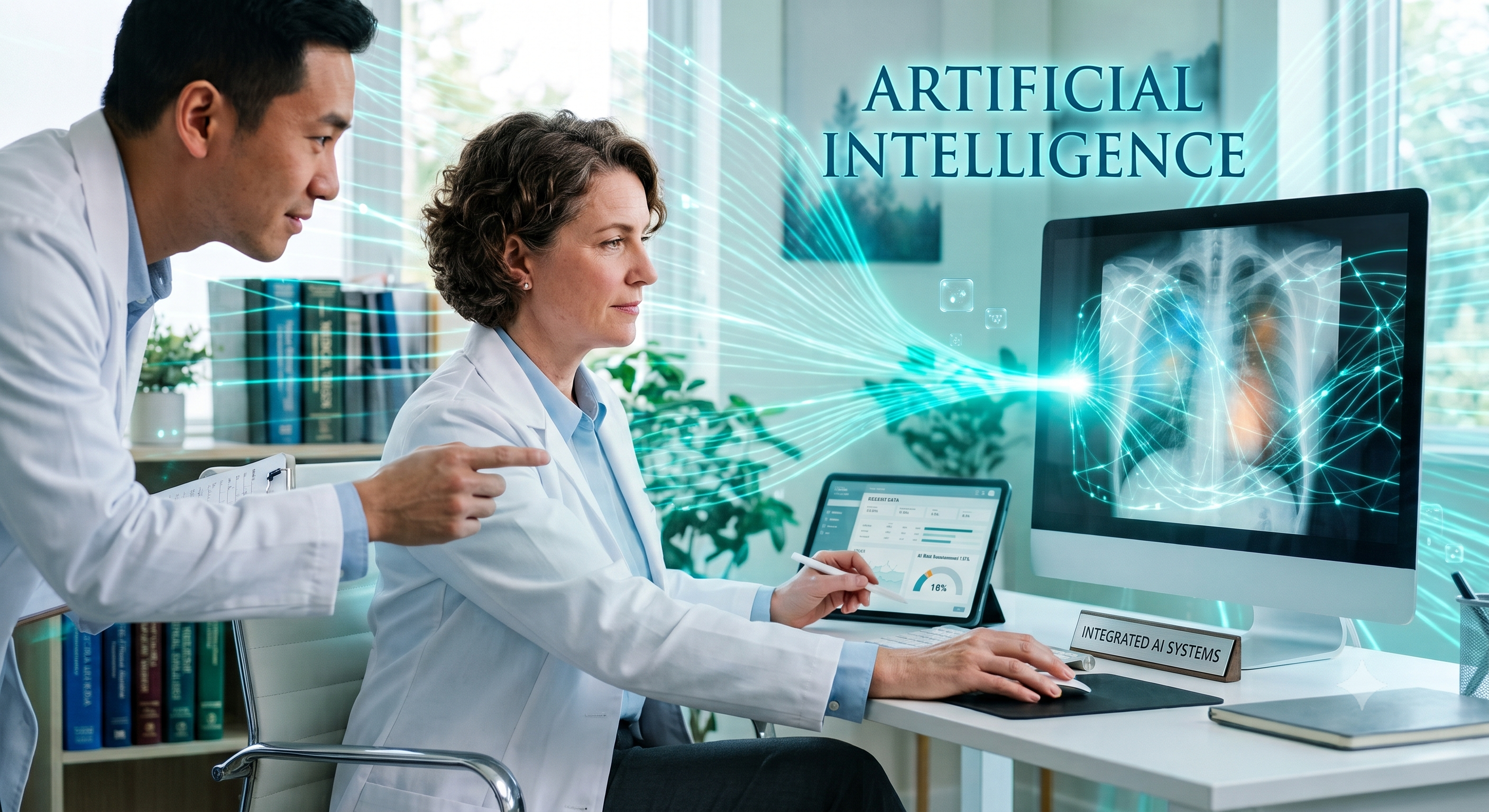
Artificial intelligence is gradually becoming part of modern healthcare, although not quite in the way science fiction once imagined. Rather than replacing doctors, AI is increasingly being developed as a supporting tool—helping healthcare professionals analyse medical images, recognise patterns in clinical information, organise large amounts of data and improve certain routine processes.
The World Health Organization (WHO) notes that AI is already playing a role in areas including diagnosis, clinical care, drug development and health-system management. [1] Its real value, however, depends on how safely and responsibly it is used.
What Does AI Mean in Healthcare?
Artificial intelligence refers broadly to computer systems capable of analysing information and performing tasks that would normally require aspects of human intelligence. Machine learning and deep learning are important branches of AI that allow systems to recognise patterns within large datasets.
In healthcare, AI may be used for:
- analysing medical images,
- supporting clinical decisions,
- identifying patterns in patient data,
- monitoring changes in health indicators,
- assisting with medical documentation,
- organising clinical information, and
- improving administrative workflows.
The purpose is not simply to automate medicine. Ideally, technology should help healthcare professionals make better use of the information available to them.
AI as a Support in Medical Diagnosis
Diagnosis is rarely based on a single test. A doctor may need to consider symptoms, medical history, examination findings, laboratory results, imaging and previous treatment before reaching a conclusion.
AI can help analyse some of this information rapidly and identify patterns that deserve closer attention.
For example, a properly designed clinical AI system may help flag unusual findings, assess combinations of medical measurements or identify patients whose results require further investigation.
This can be useful when healthcare teams are managing large volumes of information.
But an AI-generated result should not automatically be considered a diagnosis.
Its reliability depends on the quality of the data used to develop it, the patient population in which it has been tested and whether it has been appropriately validated for its intended medical use. Clinical interpretation remains essential.
Medical Imaging: Where AI Is Making a Visible Impact
Medical imaging is among the most established areas of healthcare AI.
Hospitals produce enormous numbers of X-rays, CT scans, MRI studies, mammograms, ultrasound images and other diagnostic images. Analysing these studies requires considerable specialist expertise and time.
AI-based image-analysis tools can assist by identifying or highlighting areas that may require closer review. They may also help measure anatomical structures, outline lesions or compare particular imaging features.
The US Food and Drug Administration maintains a list of authorised AI-enabled medical devices, and a significant proportion of the devices listed are associated with radiology. [2]
The important point is that such technologies are generally designed for specific clinical purposes. They do not turn a computer into an independent radiologist. Instead, they can provide another analytical tool for trained professionals.
AI Beyond Radiology
The potential applications extend well beyond imaging.
Cardiology: AI can analyse cardiovascular information such as electrocardiograms and cardiac images to identify patterns that may require further evaluation.
Oncology: Cancer treatment often involves imaging, pathology, laboratory findings and other complex information. AI can assist with areas such as tumour measurement, image analysis and data organisation.
Pathology: As pathology slides become digitised, image-analysis systems can help identify areas that a pathologist may wish to examine more closely.
Ophthalmology: AI-based analysis of retinal images has created opportunities to support screening and detection of certain eye abnormalities.
Research supported by the US National Institute of Biomedical Imaging and Bioengineering includes AI, machine learning and deep learning technologies designed to improve the analysis of complex medical images and data. [3]
How AI Can Improve Patient Care
Some of the most useful applications of AI may happen without patients seeing the technology directly.
Patient Monitoring
Hospitals and remote-monitoring programmes can generate repeated measurements such as blood pressure, pulse, oxygen saturation or glucose levels. AI-supported systems can analyse trends and help identify changes that deserve professional attention.
Managing Clinical Information
A patient receiving long-term or complex treatment may accumulate years of reports, prescriptions, investigations and hospital records. Digital tools can help organise this information and make important details easier for healthcare teams to locate.
Reducing Administrative Work
Doctors and nurses spend considerable time completing documentation and other routine administrative activities. Carefully implemented AI tools may assist with summarisation, data extraction and repetitive tasks, potentially leaving healthcare professionals with more time for direct patient care.
Generative AI, however, needs additional caution. WHO has warned that large AI models may produce responses that appear convincing while containing inaccurate information. Expert supervision, transparency and proper evaluation are therefore particularly important in healthcare. [4]
Can AI Make Healthcare More Personalised?
Every patient is different.
Age, medical history, existing diseases, medicines, genetics and response to previous treatment can influence healthcare decisions. AI systems can process several variables simultaneously, which may help clinicians assess risks or identify patterns relevant to an individual patient.
But statistical prediction is not the same as understanding a person.
A computer does not naturally understand a patient's concerns, priorities, family circumstances or attitude towards treatment. These factors remain an important part of the relationship between patient and healthcare professional.
The Risks and Limitations of Healthcare AI
The possibilities are significant, but so are the responsibilities.
Bias: If an AI system is developed using data that do not adequately represent different populations, its performance may vary between groups.
Incorrect information: Generative AI can occasionally produce inaccurate information in a confident manner. A JAMA systematic review of 519 studies evaluating healthcare applications of large language models found that only 5% used real patient-care data, highlighting the need for stronger real-world evaluation. [5]
Privacy: Medical information is highly sensitive. Healthcare AI therefore requires appropriate safeguards for data access, storage, consent and security.
Over-reliance: Even accurate systems can become dangerous if users stop questioning their results. AI should complement professional judgement rather than eliminate it.
Will AI Replace Doctors?
It is more realistic to expect AI to change how healthcare professionals work rather than make them unnecessary.
Medicine involves far more than identifying patterns. Doctors must interpret uncertainty, understand individual circumstances, discuss treatment choices, balance risks and communicate with patients and families.
AI may become extremely capable at selected technical tasks. Human judgement remains necessary to understand what those results mean for the person receiving care.
The future is therefore likely to be one of AI-assisted healthcare rather than AI-only healthcare.
Looking Ahead
The greatest impact of artificial intelligence may not come from one dramatic medical breakthrough. It may come from hundreds of smaller improvements—better image analysis, faster organisation of clinical information, smarter monitoring and more efficient hospital workflows.
The success of healthcare AI should therefore not be measured by how much technology a hospital uses. It should be measured by whether that technology contributes to safer, more efficient, equitable and patient-centred care.
AI can become a valuable partner in modern medicine, but technology works best when combined with medical expertise, responsible oversight and human judgement.
References & Sources
[1] World Health Organization (WHO).
Harnessing Artificial Intelligence for Health.
https://www.who.int/teams/digital-health-and-innovation/harnessing-artificial-intelligence-for-health
[2] U.S. Food and Drug Administration (FDA).
Artificial Intelligence-Enabled Medical Devices.
https://www.fda.gov/medical-devices/software-medical-device-samd/artificial-intelligence-enabled-medical-devices
[3] National Institute of Biomedical Imaging and Bioengineering (NIBIB), National Institutes of Health (NIH).
Artificial Intelligence, Machine Learning and Deep Learning.
https://www.nibib.nih.gov/programs/machine-learning
[4] World Health Organization (WHO).
WHO Calls for Safe and Ethical AI for Health. 16 May 2023.
https://www.who.int/news/item/16-05-2023-who-calls-for-safe-and-ethical-ai-for-health
[5] Bedi S, Liu Y, Orr-Ewing L, et al.
Testing and Evaluation of Health Care Applications of Large Language Models: A Systematic Review. JAMA. 2025;333(4):319–328.
https://jamanetwork.com/journals/jama/fullarticle/2825147
DOI: https://doi.org/10.1001/jama.2024.21700
Medical Disclaimer
This article is intended for general educational and informational purposes only. It does not constitute medical advice, diagnosis, or treatment recommendations. For any personal health concerns or medical decisions, readers should consult an appropriately qualified healthcare professional.